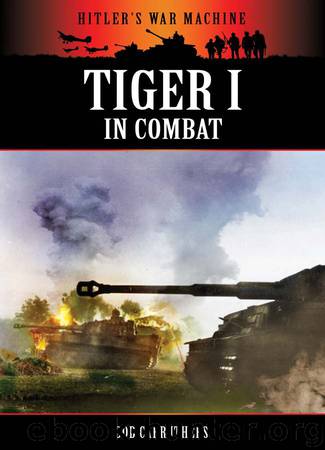
Tiger I in Combat (Hitler's War Machine) by Bob Carruthers
Author:Bob Carruthers [Carruthers, Bob]
Language: eng
Format: mobi
Publisher: Coda Books Ltd
Published: 2011-07-07T04:00:00+00:00
A Grenadier standing in front of a trio of captured Russian anti-tank guns scans the skies as a Tiger I in summer camouflage paint scheme rolls on towards the enemy.
ROAD MARCHES
Another shot of a Tiger I encountering difficult terrain and insurmountable obstacles in the Army Group North sector.
The Tiger’s extreme weight limited which bridges it could cross. It also made driving through buildings something of a lottery as basements were liable to collapse trapping the tank in the rubble. Another weakness was the slow traverse of the hydraulically-operated turret. The turret could also be traversed manually, but this option was laborious and rarely used, except for very small adjustments.
Early Tigers had a top speed of about 45 kilometres per hour (28mph) over optimal terrain. This was not recommended for normal operation, and was discouraged in training. Crews were ordered not to exceed 2600rpm due to reliability problems of the early Maybach engines with their maximum 3000rpm output. To combat this, the Tiger’s top speed was reduced to about 38 kilometres per hour (24mph) through the installation of an engine governor, capping the rpm of the Maybach HL 230 to 2600rpm (HL 210s were used on early models). Despite being slower than medium tanks of the time, which averaged a top speed of about 45 kilometres per hour (28mph), the Tiger still had a very respectable speed for a tank of its size and weight, especially if one considers the fact that the Tiger I was nearly twice as heavy as a Sherman or T-34.
The Tiger had reliability problems throughout its service life; Tiger units almost invariably entered combat under strength due to various mechanical breakdowns. It was rare for any Tiger unit to complete a road march without losing vehicles due to breakdowns. The tank also had poor radius of action ie the distance which a combat vehicle can travel and return to the battlefield without refuelling. Although the Tigerfibel gave the figure of 42.5km in each direction (see page 27) the reality was much lower - 35km across country was considered to be the maximum on a full tank. However, the Tiger I was a remarkably efficient cross-country vehicle. Due to its very wide tracks however, the Tiger did produce a lower ground pressure bearing than many smaller tanks, the most notable exception being the Soviet T-34 which also ran on comparatively wide tracks.
Download
This site does not store any files on its server. We only index and link to content provided by other sites. Please contact the content providers to delete copyright contents if any and email us, we'll remove relevant links or contents immediately.
| Africa | Americas |
| Arctic & Antarctica | Asia |
| Australia & Oceania | Europe |
| Middle East | Russia |
| United States | World |
| Ancient Civilizations | Military |
| Historical Study & Educational Resources |
The Radium Girls by Kate Moore(12090)
100 Deadly Skills by Clint Emerson(4972)
Rise and Kill First by Ronen Bergman(4836)
The Templars by Dan Jones(4732)
The Doomsday Machine by Daniel Ellsberg(4542)
The Rape of Nanking by Iris Chang(4255)
Killing England by Bill O'Reilly(4041)
Stalin by Stephen Kotkin(4003)
Hitler in Los Angeles by Steven J. Ross(3977)
12 Strong by Doug Stanton(3575)
Hitler's Monsters by Eric Kurlander(3384)
The Code Book by Simon Singh(3250)
Blood and Sand by Alex Von Tunzelmann(3240)
Darkest Hour by Anthony McCarten(3161)
The Art of War Visualized by Jessica Hagy(3043)
Hitler's Flying Saucers: A Guide to German Flying Discs of the Second World War by Stevens Henry(2777)
Babylon's Ark by Lawrence Anthony(2718)
Tobruk by Peter Fitzsimons(2559)
The Second World Wars by Victor Davis Hanson(2554)
